Understanding Kubernetes Services: Service Discovery, Load Balancing & External Exposure
When working with Kubernetes, you quickly learn how Deployments create Pods and how replica sets ensure availability.
But production systems introduce a critical networking challenge.
Pods — which encapsulate containers — are ephemeral by nature.
And that changes everything.
🔍 The Real Problem: Ephemeral Pods & Changing IPs
In Kubernetes:
Pods are temporary
If a Pod crashes, it is recreated
The recreated Pod gets:
A new IP address
A new internal identity
Possibly scheduled on another node
Now imagine:
Users connecting directly to a Pod IP
Another microservice depending on that IP
The moment the Pod restarts — the connection breaks.
Even though Kubernetes provides auto-healing, direct Pod access is unreliable in real-world environments.
This is the networking problem that Kubernetes Services solve.
🧠 What Is a Kubernetes Service?
A Service provides a stable network endpoint for a group of Pods.
Instead of accessing individual Pod IPs, clients connect to:
A virtual ClusterIP
Or a DNS name automatically created by Kubernetes
Example DNS format:
service-name.namespace.svc.cluster.local
Behind the scenes:
The Service selects Pods using labels
kube-proxy configures routing rules
Traffic is distributed to healthy Pods
This abstraction ensures reliability even when Pods are recreated.
⚙️ Core Capabilities of Kubernetes Services
1️⃣ Load Balancing
When multiple Pod replicas exist, the Service automatically distributes traffic across them.
User → Service → Pod A
                → Pod B
                → Pod C
This ensures:
Even traffic distribution
No single Pod overload
High availability
Traffic routing is implemented by kube-proxy, running on each node.
2️⃣ Service Discovery via Labels & Selectors 🔎
Services do not track Pods by IP address.
Instead, they use:
Labels (attached to Pods)
Selectors (defined in the Service)
Example:
Pod:
labels:
  app: payment
Service:
selector:
  app: payment
As long as a Pod carries that label, it becomes part of the Service.
Even if:
The Pod is deleted
A new Pod is created
The IP address changes
The Service continues routing traffic correctly.
This is automated service discovery — no manual IP management required.
🌍 Types of Kubernetes Services
According to official Kubernetes documentation, there are multiple service types. The three most commonly used in production are:
1️⃣ ClusterIP (Default)

Default Service type
Exposes the application only inside the cluster
Provides a stable internal IP
🔹 Best used for:
Microservice-to-microservice communication
Backend APIs
Databases
ClusterIP is the safest and most commonly used option.
2️⃣ NodePort
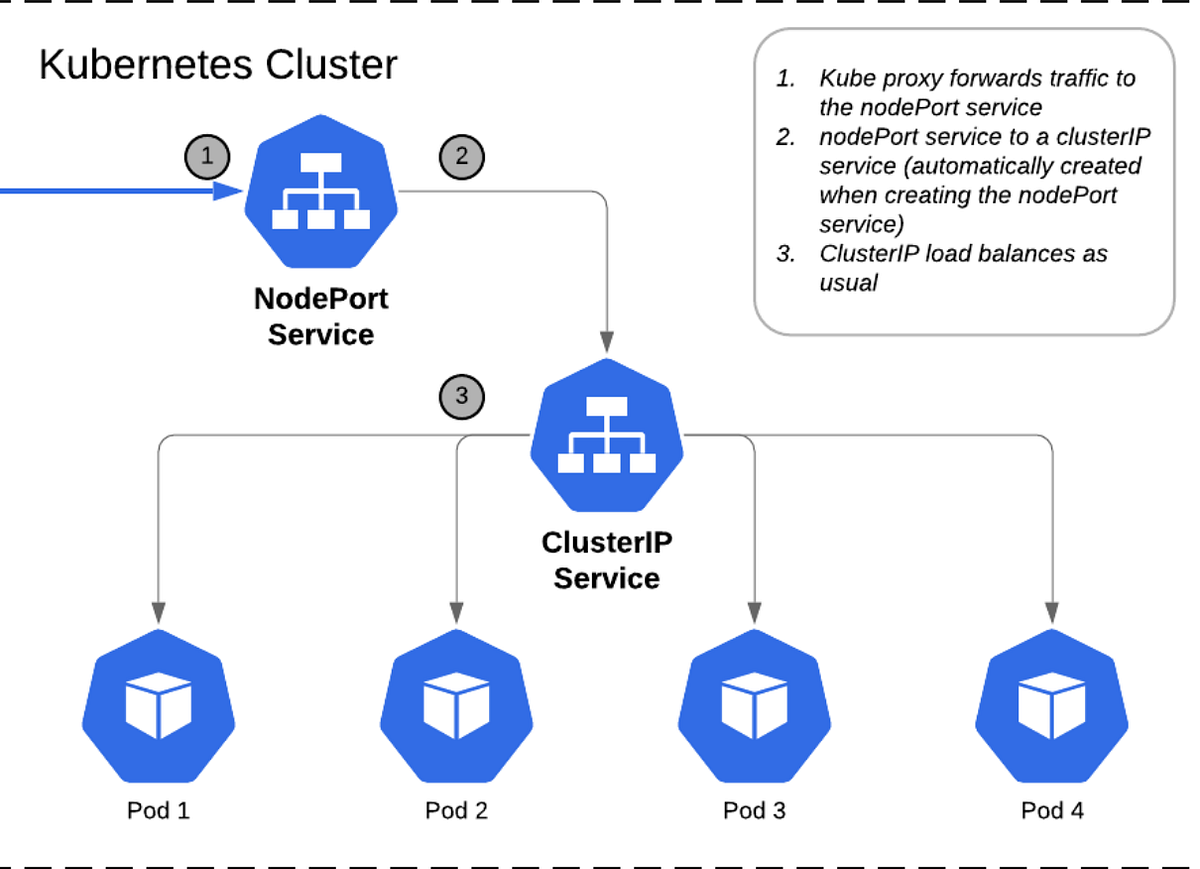
Exposes the Service on each node’s IP
Uses a static port (default range: 30000–32767)
Accessible via:
<NodeIP>:<NodePort>
🔹 Suitable for:
Internal testing
Organizational network access
Non-production environments
3️⃣ LoadBalancer ☁️

Used in cloud environments
Automatically provisions an external load balancer
Assigns a public IP
Supported by cloud providers like:
Amazon Web Services
Microsoft Azure
Google Cloud Platform
Traffic flow:
Internet → Cloud Load Balancer → Service → Pods
Ideal for production, internet-facing applications.
🧩 Behind the Scenes: How It Works
kube-proxy
Runs on every worker node
Maintains network rules
Ensures Service IP forwards traffic to correct Pods
DNS Resolution
Kubernetes provides internal DNS.
Services are discoverable using:
service-name.namespace.svc.cluster.local
This eliminates IP dependency entirely.
🎯 Key Takeaways
Pods are ephemeral — their IP addresses change
Services provide a stable network abstraction
Labels and selectors power dynamic service discovery
Load balancing happens automatically
Service type determines exposure level
Without Services, Kubernetes networking would be fragile and unreliable.
With Services, it becomes production-grade and scalable.